
Contents |
Introduction
The "Reporting" feature helps you track loans and create activity reports for your programme's institutions.
It also lets you edit file information in bulk, such as reporting dates or validation dates, so you can easily update distributors on the final decision of their guaranteed loan application.
1. Access the Reporting feature
The Reporting feature is available on every published programme, whether in distribution or paused.
From your programme's home page, click the Reporting button in the top right corner.
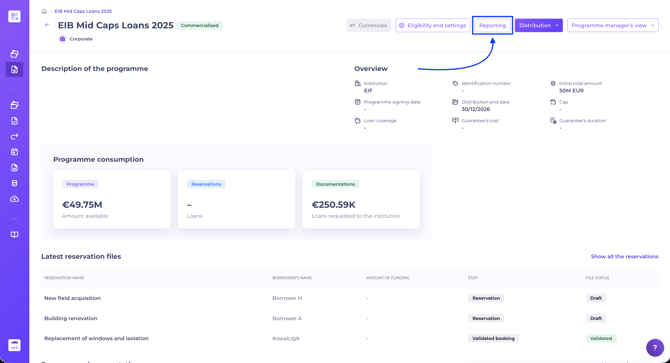
Distributors also have access to this feature, but their view of files is limited to their own portfolio, and they cannot edit any information.
2. Create a reporting template
A reporting template lets you select the fields you want to export, among all the fields available on your programme. You can create and save your favourite templates to reuse them as often as needed.
Click "Create a new template" in the top right corner. Choose a name, then configure your template on the page that opens:
- On the left, the list of all available export fields.
- On the right, the fields you select for your template.
Tick the fields you want on the left, then use the arrow [➞] between the two tables to add them to your template. Rearrange the order of the selected fields as you wish.
Among the available fields, you find the Financing object status and the Decline reason, which allow fine-grained tracking at the financing object level.
![[DE] Reporting - création template (EN)](https://www.kls-desk.com/hs-fs/hubfs/%5BDE%5D%20Reporting%20-%20cr%C3%A9ation%20template%20(EN).gif?width=670&height=320&name=%5BDE%5D%20Reporting%20-%20cr%C3%A9ation%20template%20(EN).gif)
To continue, click "Actions" in the top right corner, then "Start reporting".
Once your templates are saved, click directly on "Start reporting" without going through the creation step again.
3. Import external data into Kls
Some information required for your reporting is not collected through Debt Eligibility (for example, credit data from an internal tool).
You can import this data into the Reporting feature to centralise everything and build a complete report.
On the Reporting home page, next to the template creation button, click the data import button. The import file is an Excel file to download from the dropdown menu in the top right corner.
Complete the file, then re-import it. The data is added to your next reporting.
![[DE] Reporting - Import fichier (CRD ou Paiement garantie) (EN)](https://www.kls-desk.com/hs-fs/hubfs/%5BDE%5D%20Reporting%20-%20Import%20fichier%20(CRD%20ou%20Paiement%20garantie)%20(EN).gif?width=670&height=320&name=%5BDE%5D%20Reporting%20-%20Import%20fichier%20(CRD%20ou%20Paiement%20garantie)%20(EN).gif)
The data that can be imported is currently: CRD (Capital Outstanding), Maturity and guarantee payment information. For other needs, contact your Kls account manager.
Return to the Reporting home page to launch a data export from one of your templates.
4. Edit and export your data
The editing interface lets you view, edit and export data related to your programme.
Use the filters on the left to refine your search. The central table lists the financing objects of your programme, with the first column displaying the editable reporting information. The next columns reflect the fields you selected in your template.
Select all or some of the rows, then edit the dates. Only the selected rows are modified.
Completing the validation date moves the financing object to Validated status. The status of the associated file is automatically recalculated based on the statuses of all its financing objects.
To undo a change, use the "Reset field to 0" button. Resetting the validation date to zero returns the financing object to the status Documented. The associated file status is automatically recalculated.
![[DE] Reporting - Édition des dates (EN)](https://www.kls-desk.com/hs-fs/hubfs/%5BDE%5D%20Reporting%20-%20%C3%89dition%20des%20dates%20(EN).gif?width=670&height=320&name=%5BDE%5D%20Reporting%20-%20%C3%89dition%20des%20dates%20(EN).gif)
To export, click "Export all". The app generates an Excel file with all the visible information. Use it for internal data processing, to feed your tools, or to generate your regulatory reports.
To filter your files by financing object status (for example for a quarterly report), see the dedicated article: How to manage reporting of files with multiple financing objects.